Discover Our Majors: Nuclear Engineering

Nuclear Engineering Overview
- What do nuclear engineers do? What job opportunities are available? Nuclear engineers develop and manage systems that allow nuclear energy and radiation to be used safely. Nuclear engineers can work in the private or public sector in fields like nuclear power production, medical therapy and imaging, and space exploration.
- What are the salary prospects for a nuclear engineer? The median pay for nuclear engineers is $133,970, according to the Bureau of Labor Statistics.
- Why major in nuclear engineering at NC State? NC State is home to the nation’s first — and North Carolina’s only — nuclear engineering program. The Department of Nuclear Engineering offers a B.S. in nuclear engineering, an accelerated master’s program and a highly ranked graduate program. NC State consistently ranks among the best values in higher education.
Ethan Newhouse ’23 wants to help solve the country’s energy crisis, and he believes nuclear energy is the most accessible and sustainable way to do so. He completed a B.S. in nuclear engineering and a minor in mathematics in 2023 and remained at NC State to pursue a doctorate. Now a third-year nuclear engineering Ph.D. candidate, Newhouse spends his days in the lab experimenting with ways to create semiconductors without using dangerous gases and materials like lead and arsenic. The goal is to develop more affordable safety systems that promote safer nuclear energy.
“I want to show the public that nuclear energy is super safe compared to any other form,” Newhouse said. “And that’s honestly my main reason for pursuing this degree.”
The switch from undergraduate to graduate school was an adjustment, but one thing remained the same. Newhouse is one of many NC State engineering students who play in the university’s music ensembles, which are open to all students, regardless of major. Throughout his undergraduate career, Newhouse played saxophone in NC State’s marching and pep bands, jazz orchestra and wind ensemble. As a graduate student, he remains part of the latter two.
Tune in to Newhouse’s story about how he knew nuclear engineering was right for him, and how he balances a rigorous program with hobbies that fill his cup.
Deciding on a Nuclear Engineering Major
Newhouse is well into his Ph.D. program. But only seven years ago, he was a first-year undergraduate student trying to figure out his path. He originally came to NC State as an environmental science major, before deciding that nuclear engineering would allow him to more effectively combat the energy crisis and climate change.
“I took an AP Earth Science class in high school, and my teacher really spoke to me about the need to solve the energy crisis, climate change and a lot of these bigger issues where it felt like there wouldn’t be enough for future generations,” Newhouse said. “I wanted to do my part. I switched to nuclear engineering because I think it is the best form of energy that we can produce currently with minimal amounts of drawback.”

In the nuclear engineering program, Newhouse took courses in physics, chemistry, calculus, reactor analysis and design, and his favorite, Applied Differential Equations II.
“Differential equations is the math involved behind a lot of the nuclear engineering theorems that we use day to day,” Newhouse explained. “The course definitely set me up for success to take a lot of the heavier nuclear courses, specifically with neutron transport equations and a lot of thermal hydraulics courses that I ended up taking during my junior and senior year.”
Newhouse had found the major that best aligned with his goals, but by his senior year, he still wasn’t sure in which direction to go.
“I didn’t know what concentration of nuclear engineering I wanted to go into,” he said. “I knew there were multiple options. I could go into power generation and work with reactors, or work with fuel management and reactor optimization. I could also focus more on safety and making new nuclear materials to protect nuclear reactors or work on nuclear criticality.”

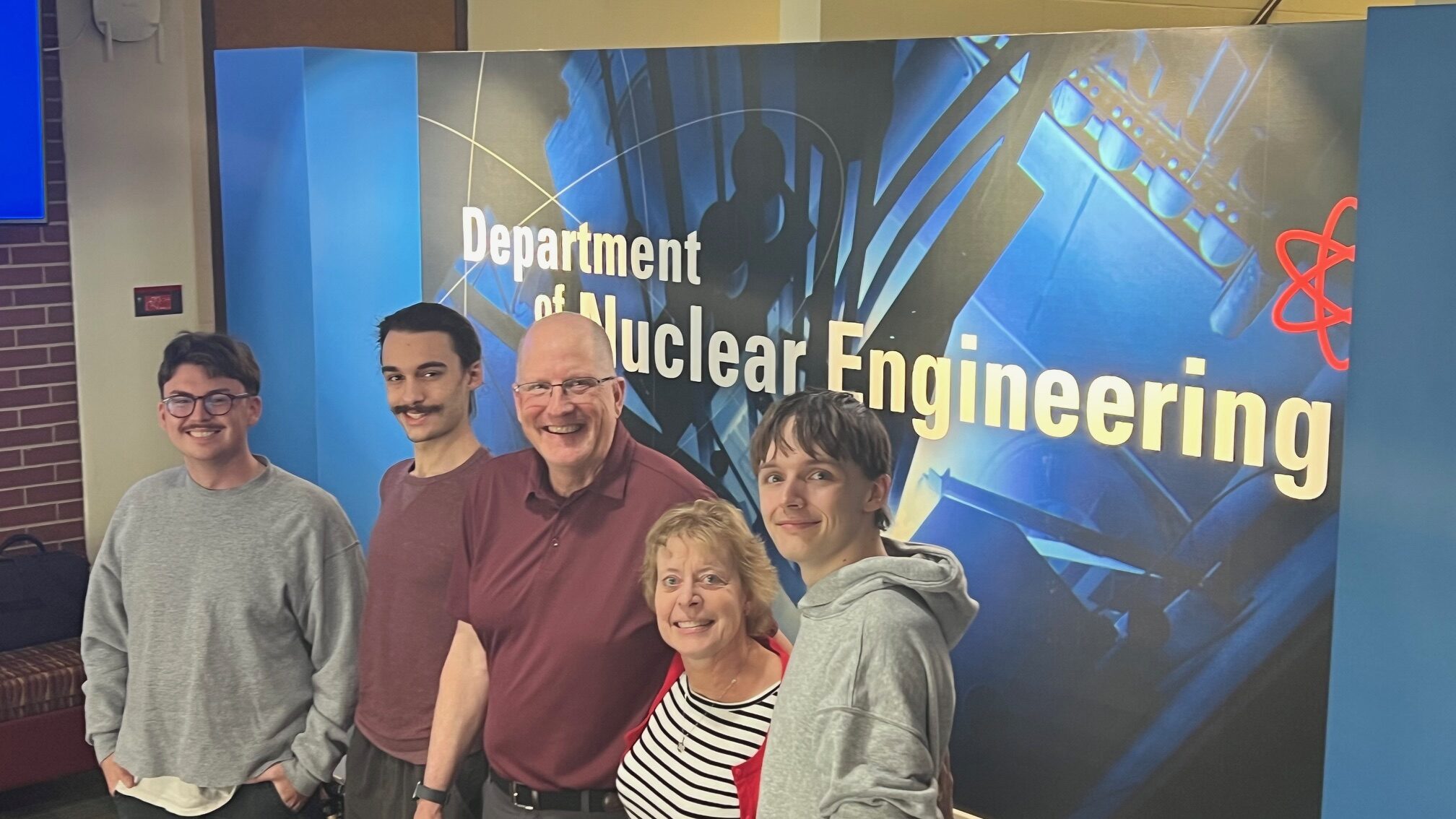
While Newhouse was serving as a counselor for the Department of Nuclear Engineering’s pre-college summer program between his junior and senior year, Lisa Marshall encouraged him to pursue a Ph.D. Marshall is an assistant extension professor, the associate director of undergraduate programs, and the director of outreach, retention and engagement at the Department of Nuclear Engineering.
“She talked to me about how easy it would be to talk to my advisor, Professor Ge Yang — who I was doing research for — to have him sponsor my Ph.D studies,” he said. “She said this would open up a lot more opportunities, and it would give me time to figure out if this is what I wanted to do or not.”
Balancing Academics and Extracurriculars
Throughout his undergraduate years, between classes, research and serving as vice president of the American Nuclear Society, Newhouse could be found rehearsing and performing with the marching band, jazz band or wind ensemble.
“I think my favorite part about being involved with the bands is the people I get to play with,” he said. “If my bandmates weren’t as great as they were, and if the environment was not as fun and fulfilling as it was, I probably would not have done it as long as I did.”
He credits his involvement in the performance groups with deepening his connection to NC State.
“Coming into college, I wasn’t the type that was very school spirited and I think the marching band completely flipped that around,” Newhouse said. “Going to every single football game and every single women’s and men’s basketball game really lets you see how hard those student athletes are working, and all the staff who support the teams behind the scenes.”
One piece of advice Newhouse has for engineering students is to space out their classes to make room for self-care and hobbies.
“Coming into college, I wasn’t the type that was very school spirited and I think the marching band completely flipped that around,” Newhouse said. “Going to every single football game and every single women’s and men’s basketball game really lets you see how hard those student athletes are working, and all the staff who support the teams behind the scenes.”

One piece of advice Newhouse has for engineering students is to space out their classes to make room for self-care and hobbies.
“Don’t overload your class schedule too much,” he said. “A lot of my friends would take 18 or 19 credit hour semesters to graduate in four years. As great as that is, I don’t see the rush to it. Taking an extra semester or an extra year to complete your degree is not going to kill your chances of getting a job after college.”
Newhouse also encourages engineering students to explore everything NC State has to offer in their first year.
“One NC State tradition I think every student should definitely do is they should definitely go to Packapalooza,” he said. “Going to sporting events like football, basketball and soccer games — along with all of the first-year experiences NC State has to offer — is the best way to enjoy your freshman year.”
As a graduate student, he’s had to change his approach to balancing his research and band rehearsals. His undergraduate schedule was structured, with classes and band practices being held at set times.
“I remember the switch from undergrad to grad was a big shock to me,” Newhouse said. “In grad school, you have to set your own schedule so that you can make progress on your degree, because your professors are not going to be hovering over your shoulder.”
Despite the adjustment, keeping jazz band and wind ensemble as part of his routine has been essential for Newhouse.
“Paul Garcia, the wind ensemble director, and Wes Parker, the jazz orchestra director, created those programs as a great safe haven for me and a lot of other engineering students who just want to break from the academic rigor that we go through on a daily basis,” Newhouse said. “I’m enjoying it while I can before I graduate, because I don’t think I’m going to have the opportunity to play with as high of a caliber of music groups that I’m able to play with now at State.”
This post was originally published in NC State News.